Thursday, January 8
1:30 - 3:30 pm
Clareview Recreation Centre
2704 17 St NW

Thank you for participating! Stay tuned for the final What We Heard report.
The City of Edmonton is doing a Climate Action Plan Update (2027-2030) to ensure our existing climate strategies remain effective and adapt to changing local priorities. The actions will build off of the progress the City has made so far in responding to a changing climate.
Please refer to the City’s Approach To Responding To Climate Change for more information on the progress and how that progress will be referenced in the updated action plan.
We are inviting Edmontonians to view the draft ideas (action concepts) and provide feedback on what might be missing or needs to be adjusted. An overview of the draft action concepts is provided below and for more details please refer to the Draft Actions Concepts.
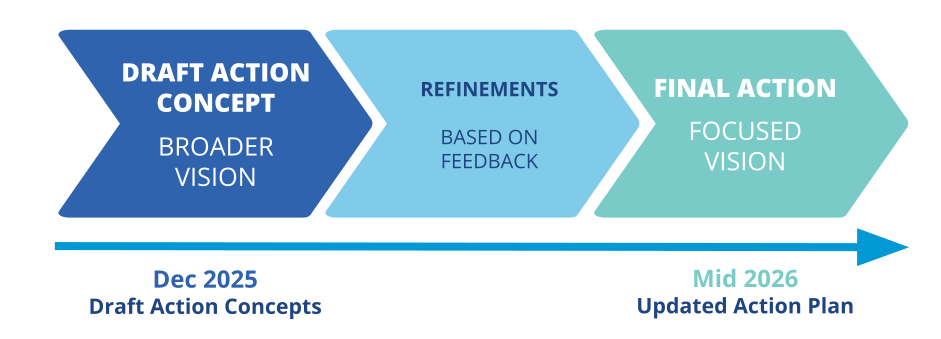
Public engagement will be ongoing from December 5, 2025 to January 30, 2026. Feedback received during this time will inform the final recommended actions that will be included in the Climate Action Plan Update (2027-2030). This may include changing, adding, or removing concepts based on input received.
The final action plan will be brought to City Council in mid-2026.
DRAFT ACTION CONCEPTS are the high-level action statements that describe what climate action the City is proposing. The figure below illustrates how the draft action concepts are organized into Action Categories and demonstrates the additional connection to the action concepts to benefits beyond climate.
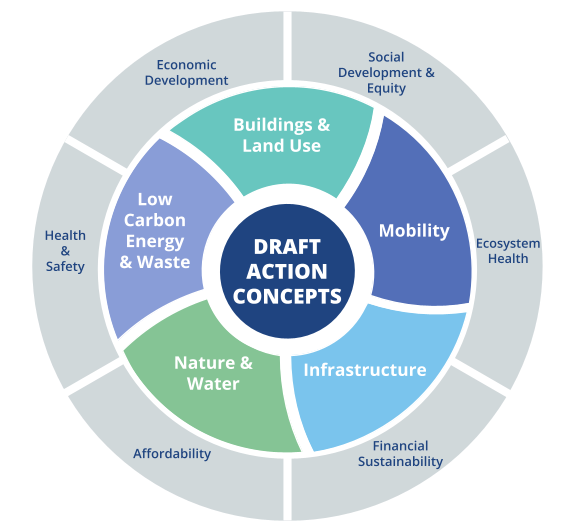
ACTION CONCEPT CATEGORIES (multi-coloured ring of figure) are how the action concepts are organized.
BENEFITS BEYOND CLIMATE (outer grey ring of figure) are the intended benefits of action concepts to other important priorities, such as affordability, equity and economic development. Each individual action concept identifies the relevant benefits beyond building climate resilience.
In the action details, each action concept also identifies if the primary focus of the action is adaptation, energy transition, or both.
Adaptation Actions are actions that respond to and address the risks of a changing climate, including preparing for changing temperatures, precipitation, weather extremes, and changing ecosystems.
Energy Transition Actions are actions that reduce or prevent the release of greenhouse gases to the atmosphere in an effort to slow climate change. Examples include using renewable energy, improving energy efficiency, and transitioning away from fossil fuels.
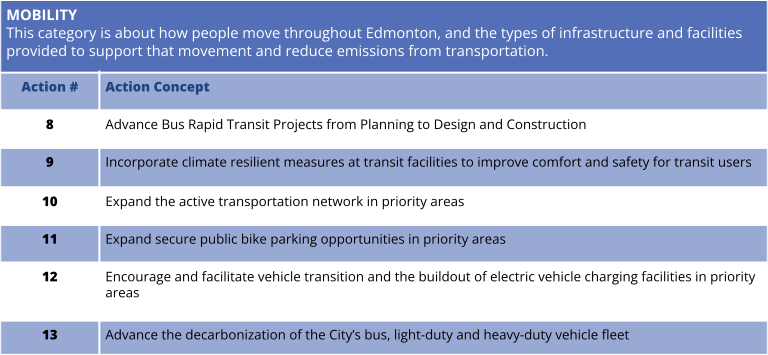
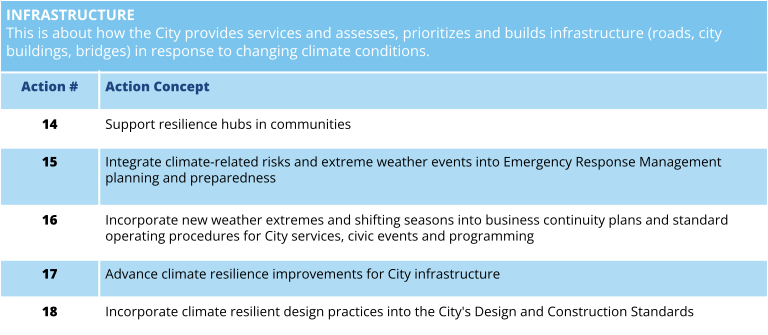
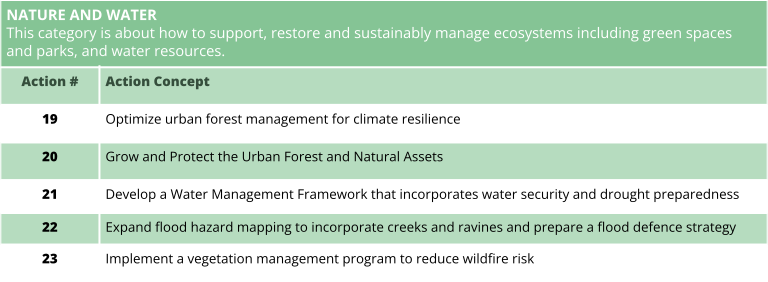
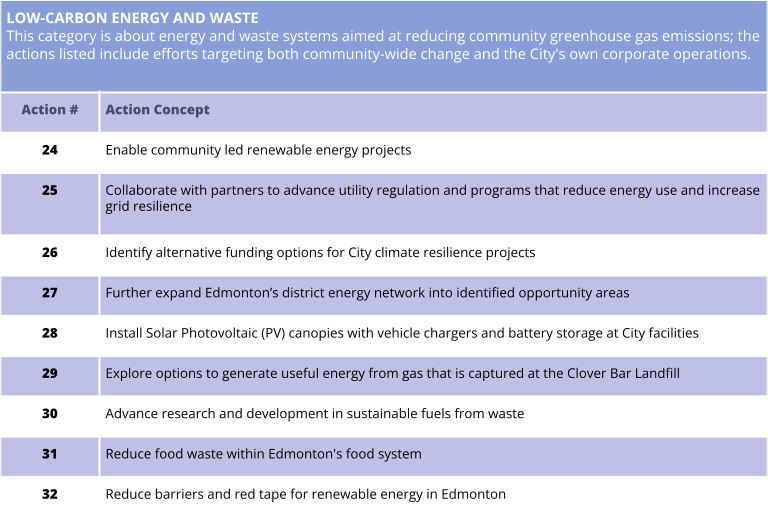
Below is a high-level summary of the draft action concepts. To view more details, please refer to the Draft Action Concepts.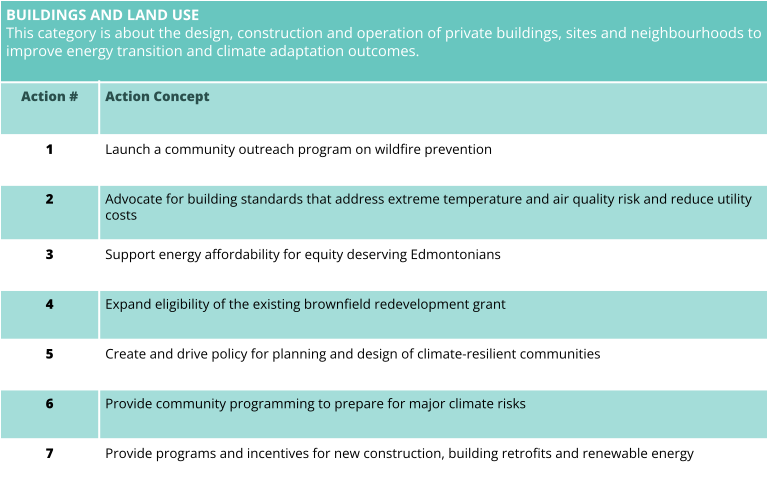
There are a variety of ways to provide feedback. Some opportunities, such as sharing your thoughts, asking a question, and scheduling a chat with the project team are available throughout the entire engagement period. Other opportunities, such as the survey and the pop-ups, are available throughout January.
Submit a question below to the project team or see what others have been asking. Questions will be posted as they are responded to. The project team strives to respond to questions as soon as possible, however, response times may be delayed over the holiday season.
Please note you must register on Engaged Edmonton to ask a question. You will need to provide a screen name and email to register as all questions go through an automated moderation process. Your screen name will be displayed but all other information is kept confidential.
If you are unable to ask your question on this site, you may also ask your question to the project team by emailing climatestrategyandplanning@edmonton.ca. Please avoid asking your question in two different places, such as emailing the team as well as posting on this site. It is not necessary to do both in order for feedback to be captured, and may delay response times.To ask a question you must create an account or log in.
These are the people that are listening and responding to your questions.
{{question.description}}
Schedule a time to meet one-on-one with a member of the project team to provide your feedback on the Climate Action Plan Update (2027-2030).
Book a time to chat with the project team via Google Meet here. Phone or in-person meeting option available upon request.
Please note that there is a limited number of meeting slots available on a first come, first serve basis.
We will be at various locations around the city in January. Stop by one of the locations below to chat with the project team, learn more about the project and provide your feedback.
1:30 - 3:30 pm
Clareview Recreation Centre
2704 17 St NW
2:00 - 4:00 pm
Mill Woods Towne Centre - near the Hewes Way entrance by Shoppers Drug Mart
2331 66 St NW
9:30 am - 11:30 am
Stanley Milner Library
7 Sir Winston Churchill Sq NW
11:00 am - 3:00 pm
Students’ Union Building, University of Alberta
8900 114 St NW
12:00 pm - 3:00 pm
Telus World of Science - Main Lobby
11211 142 St NW
Complete our survey to provide your feedback on the Climate Action Plan Update (2027-2030). The survey is open January 5 - 30, 2026.
The Community Energy Transition Strategy and Action Plan, approved by Council in 2021, sets ambitious targets for reducing GHG emissions and outlines key pathways for the City’s energy transition.
The Energy Transition Strategy sets out clear interim targets to meet the City Plan’s goal of net-zero per-person GHG emissions:
The Energy Transition Strategy lays out four pathways, supported by goals, strategies, and actions, to guide Edmonton’s climate resilience goal of a low carbon city:
The Climate Resilient Edmonton: Adaptation Strategy and Action Plan, approved by Council in 2020, outlines actions to enable the City and its residents to respond to the impacts of climate change - protecting the community, infrastructure and services. The Adaptation Strategy lays out pathways, goals, and actions to address climate impacts facing Edmonton today and into the future.
The Adaptation Strategy outlines five paths to climate resilience; the paths connect science-based decisionmaking with the primary climate change impacts identified for Edmonton:
To support implementation of the two strategies, City Council adopted an integrated Climate Resilience Policy, which states the City of Edmonton commits to immediately and urgently:
The purpose of this policy is to provide clear and consistent governance and accountabilities for achieving a climate resilient community, and to demonstrate to Edmonton’s citizens, businesses, and community and industry partners the City of Edmonton's commitment to climate solution leadership in all aspects of city planning, development and business decisions.
The implementation of our existing actions have resulted in established processes that integrate climate action practices into City programs, services, and projects. These established processes are now considered our foundational actions and will continue to mature and strengthen over time. Examples of this continued implementation include:
The Updated Climate Action Plan (2027–2030) will explicitly reference these ongoing foundational practices within Administration to signal their importance and ensure continuity. The action concepts below, which will be detailed within the Updated Climate Action Plan (2027–2030), are designed to complement the progress that has already been made and further advance our overarching climate strategies.
For more information, please refer to Additional Info - City’s Approach To Responding To Climate Change and check out the City’s Climate Action Dashboard.
Edmonton’s climate is changing. These changes are disrupting the social, economic, and environmental systems that support our quality of life. A study specific to Edmonton found that climate change could cause direct annual costs of approximately $1 billion as early as the 2040s, and up to $4 billion yearly as early as 2070s (Boyd, R. 2022. Costs of inaction: Economic impacts of climate change on Edmonton). Observations indicate that changes to temperature, precipitation, and extreme weather events are already occurring. In fact, Edmonton is warming at a rate faster than the global average, with 2023 standing as the hottest year on record. When looking to the future, scientists predict that Edmonton will see higher temperatures, more drought and flooding events, more extreme weather events, and the transformation of local ecosystems.
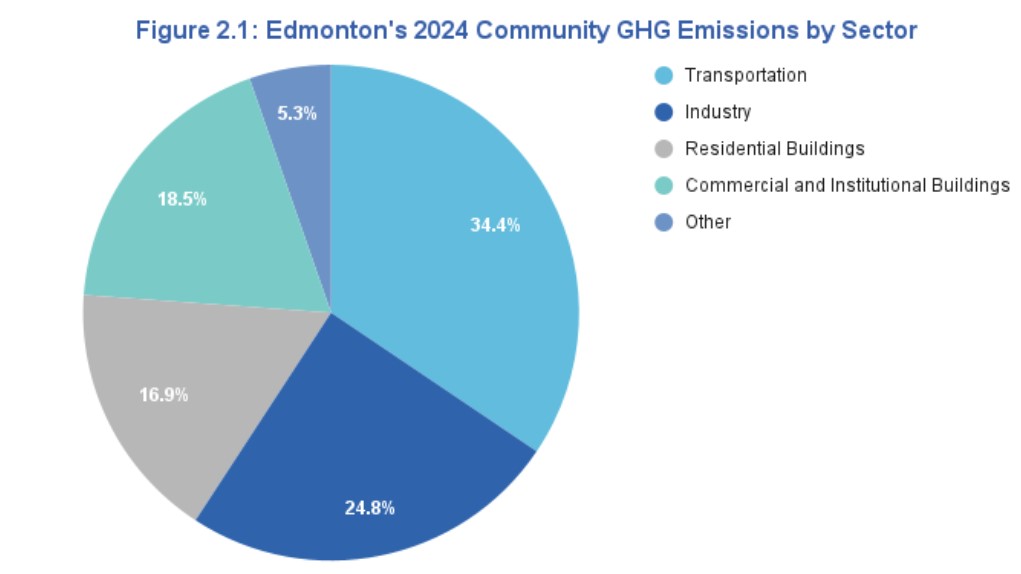
The primary sources of greenhouse gas emissions in our community are from the transportation, industry, and residential building sectors.
For more details on the local impacts of climate change, please refer to Additional Info - Climate Change In Edmonton.The foundations of the climate strategies continue to guide the City’s climate action approach. In addition, the following principles are being used to inform action concepts:

We acknowledge the traditional land on which we reside, is in Treaty Six Territory. We would like to thank the diverse Indigenous Peoples whose ancestors’ footsteps have marked this territory for centuries, such as nêhiyaw (Cree), Dené, Anishinaabe (Saulteaux), Nakota Isga (Nakota Sioux), and Niitsitapi (Blackfoot) peoples. We also acknowledge this as the Métis’ homeland and the home of one of the largest communities of Inuit south of the 60th parallel. It is a welcoming place for all peoples who come from around the world to share Edmonton as a home. Together we call upon all of our collective, honoured traditions and spirits to work in building a great city for today and future generations.