**The discussion has concluded.
Thank you for providing feedback for consideration. A What We Heard Report which summarizes the feedback received is now available.
The application is expected to go to City Council Public Hearing for a decision, with the exact date still to be determined. For more information, please visit these Frequently Asked Questions for Council meetings.
The Engaged Edmonton pages for 11054 - 84 Avenue and the Garneau Special Character Residential Area have been combined into a single page to share information and gather input. Having two separate pages potentially caused confusion and this change should make it easier for participants to provide input.
There are two tools (Ask a Question & Share Your Thoughts) that were originally on the Garneau Special Character Area page that are closed for further input as the updated zone will maintain existing development rights. However, all past questions and responses can be viewed below. Please use the tools under the label for 11054 - 84 Avenue NW to share any comments and questions.
This is a single rezoning application submitted by Anonymous Architecture on behalf of a landowner for the purpose of developing multi-unit housing with secondary suites at 11054 - 84 Avenue NW. This also requires updates to the Garneau Special Character Residential Area to align the formatting and writing standards with Zoning Bylaw 20001.
Get involved!
You are invited to learn more about the application and share feedback online. The following engagement opportunities are open from April 07, 2026 until April 26, 2026.
- Learn More about the application, how feedback is used and next steps
- Ask a Question to the Project Planner for any questions you have about the application
- Share Your Thoughts about the application
What Happens Next
We will use feedback shared to make sure our review of the application is as complete as possible. After engagement is closed, feedback received will be summarized in a What We Heard report for City Council so that they know your perspective prior to making a decision.
LDA26-0054 Garneau Rezoning Engagement (11054 - 84 Avenue NW)
Learn More
The City is reviewing a rezoning application from Anonymous Architecture for 11054 - 84 Avenue in the Garneau neighbourhood. The current zoning is a Direct Development Control Provision (DC1.6220), also known as the Garneau Special Character Residential Area, and the proposed zone is a new Direct Control Zone (DC). Key characteristics of the proposed DC include:
- A maximum of 6 dwellings
- A maximum height of 10.5 metres
- A maximum site coverage of 45%
- Architectural features that complement the urban design elements of the area
The proposed site specific zoning applies to one property as shown in grey below. The broader Garneau Special Character Residential Area remains unchanged with the exception of updates to Zoning Bylaw 20001 writing standards.
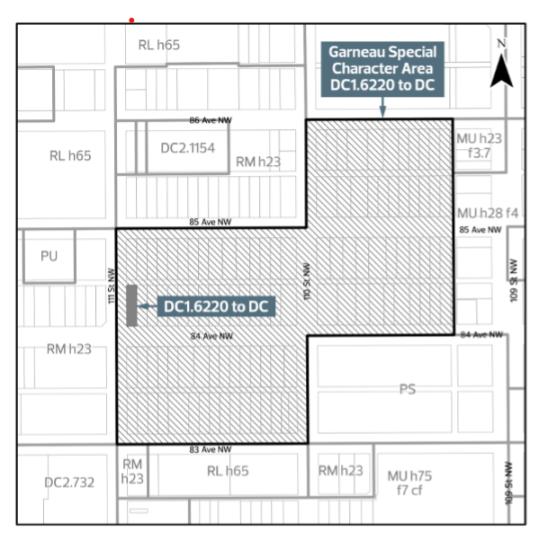
Below is a table comparing key differences between the current and proposed zones. The complete regulations are viewable under the document library.
DC1.6220 (Current) | DC (Garneau Special Character Area) | Proposed DC (11054 - 84 Avenue) | |
Permitted Uses |
|
|
|
Maximum number of Dwellings | 4 | 4 | 6 |
Minimum Site Dimension Requirements | Yes | No | No |
Maximum Height | 10 m and 2 ½ storeys | 10 m | 10.5 m |
Maximum Site Coverage | 40% (28% for principal building and 12% for accessory) | 40% (28% for principal building and 12% for accessory) | 45% |
Front Setback (84 Avenue) | 6 m | 6 m | 4.5 m |
Rear Setback (Alley) | 4.5 - 7.5 m | 7.5 m | 7.5 m |
Flanking Setback (111 Street) | 20% of site width to a maximum of 4.5 m | 1.2 - 4.5 m | 1.2 m |
Interior Setback | 1.2 - 2.0 m & 20% of site width to a maximum of 6.0 m. | 1.2 - 1.9 m | 1.2 m - 1.9 m |
Design Regulations |
|
|
|
Policy Context
The City Plan calls for more intense forms of development to follow a network of nodes and corridors, while recognizing that all areas of the city will densify over time. This area of the City falls under the Scona District Plan, with the District Policy also being applied. The Scona District Plan designates the site as Urban Mix, a general land use category which includes housing, shops, services, and offices, as well as being located within the University Garneau Major Node and a municipal heritage character area.
The University-Garneau Major Node is anchored by the University of Alberta, a large employment centre which attracts students and professionals from across Canada and internationally. With a diverse range of housing and employment options, along with multiple transportation connections, it stands as a key hub within Edmonton and is anticipated to see further expansion in both population and employment as the City grows to a population of 1.25 million.
Within a Major Node, low and mid-rise developments (4 - 8 Storeys) are supported throughout the entire node with larger buildings possible along major roads, near mass transit stations, and on large sites . However, this area is subject to area-specific policy (A.1 Garneau Special Character Residential Area) which allows residential infill that both maintains the height, scale and character of the area and maintains the existing streetscape, including landscaping, building setbacks and the retention of existing vegetation.
A Land Development Application (LDA) will be submitted when a developer wants to complete a build on a piece of land that does not currently allow for that kind of build. The LDA proposes a change in zoning, which are the rules for what can be built on the land. Only City Council has the authority to change zoning through a bylaw. The LDA process creates a bylaw for Council’s consideration and, if approved, the rules (zoning) for what can be built on the land are changed.
There are three main groups who facilitate the Land Development Application process:
1) Developers (the Applicant) will submit a Land Development Application (LDA) when they intend on starting a development on a piece of land not currently zoned for their desired build.
2) City Planners (the Project Team) will receive this LDA from the applicant. They will coordinate a review by many different experts from within and outside City Administration to develop an overall recommendation to City Council. This review includes technical and legal aspects as well as a comparison of the proposal with Council approved policies and planning principles. They will also initiate a public engagement process, with support from other City staff. This engagement process will collect feedback from Edmontonians who may be impacted by the rezoning. More information on how this process works can be found in the ‘How is the feedback collected on this page used?’ section below.
3) City Council (Decision Makers) are the final decision makers on whether or not an LDA bylaw will be approved, thereby rezoning the land. They will make this decision at a Public Hearing. In this Hearing, City Planners will present the LDA to Council, outline their planning analysis and share a summary of engagement feedback. The developer may also be in attendance to present their proposal and answer questions from Council.
The public has two main points that they can provide feedback on a proposed LDA:
1) Public Engagement with City Planners - the public are able to provide feedback directly to City staff while the Land Development Application is in the engagement phase before it is brought to council. That feedback will be shared with Council in summary form, which will provide necessary context for their decision making.
2) Council Public Hearing - the public may register and attend the Public Hearing about the LDA. Here, they can speak directly with council and share their thoughts, before the vote is cast.
The role of the public when participating in engagement activities for proposed rezonings is at the ADVISE level of the City’s Public Engagement Spectrum. This means that the City will use any feedback you share to:
- Inform the City’s planning analysis and ensure all factors are taken into consideration
- Help inform conversations with the applicant about making revisions to address concerns
- Summarize feedback for City Council so they are aware of the public’s perspectives prior to making a decision at Public Hearing
A What We Heard report that summarises the feedback received is posted online and provided to the Ward Councillor as well as anyone who registers and provides feedback through this page or by contacting the file planner directly.
City planners use the Public Engagement Charter for rezonings as a guide when determining what type of engagement activities are most appropriate to help inform rezoning proposal reviews
Please Note: Because standard zones apply to multiple sites across the city, the City cannot adjust or customize the individual regulations within these zones. When rezoning to a Direct Control zone (DC), there is opportunity for public engagement to influence adjustments to the proposed site specific regulations because these zones are only applied to a specific site or area.
Public Hearing
Once Administration completes its review and has determined its recommendation and the applicant is ready to take the application to City Council for a decision, the City sets a Public Hearing date. Notices are sent to all property owners within a minimum of 60 metres of the site in accordance with the Zoning Bylaw. In addition, notices of Public Hearing are sent to affected community leagues and business associations advising them of the Public Hearing date and how to participate.
Register to Speak to Council or Submit Comments
Public Hearings are an important part of the engagement process for rezonings. Once the hearing agenda is posted, members of the public can register to speak at the City Council Public Hearing to share their views on the proposed rezoning directly with the Council.
Written comments can also be submitted to City Council through the Office of the City Clerk. Edmontonians can also watch the Public Hearing online.
If the Application is Approved
If the rezoning is approved by Council, the next step is for the developer to apply for development and building permits to start construction. Timelines for submitting these applications and starting construction are typically at the developer’s discretion.
Ask a Question
Ask Us Questions About The Application
Submit a question below to the file planner or see what others have been asking. Your question and response to your question will be posted within 5-10 business days. When needed, we will also work with the applicant to provide an answer.
Please note you must register on Engaged Edmonton to ask a question.
Please ask a question below that will go directly to the City file planner who is processing the application.
If you are unable to provide feedback on this site, you may also provide feedback to the Project Planner directly via the contact information under the "who's listening" section of the page. Please avoid asking your question in two different places, such as emailing the planner as well as posting on this site. It is not necessary to do both in order for feedback to be captured, and may delay response times.
To ask a question you must create an account or log in.
These are the people that are listening and responding to your questions.

Jordan McArthur
Planner II
{{question.description}}
Share Your Thoughts
Tell Us What You Think About the Application
Please let us know what you like and what could be better about this application. What should Council know as they decide whether or not to approve the rezoning? Other people that visit this part of the site will be able to see your comments.
Please note you must register on Engaged Edmonton to provide feedback. Only your username will be displayed publicly, all other contact information is kept confidential. All comments go through an automated moderation process.
If you are unable to provide feedback on this site, you may also provide feedback to the Project Planner directly via the contact information under the "who's listening" section of the page.
Please avoid providing your feedback in two different places, such as emailing the planner as well as posting on this site. It is not necessary to do both in order for feedback to be captured and may delay response times.
Garneau Special Character Area Engagement (Closed for Input)
The Engaged Edmonton pages for 11054 - 84 Avenue and the Garneau Special Character Residential Area have been combined into a single page to share information and gather input. Having two separate pages potentially caused confusion and this change should make it easier for participants to provide input.
Ask a Question
This tool was originally on the Garneau Special Character Area page and is closed for further input, however, all past questions and responses can be viewed below. Please use the tools above to share any application comments and questions.
To ask a question you must create an account or log in.
These are the people that are listening and responding to your questions.
Jordan McArthur
Planner II
{{question.description}}
Share Your Thoughts
This tool was originally on the Garneau Special Character Area page and is closed for further input, however, all past comments can be viewed below. Please use the tools above to share any application comments and questions. |